发布日期:2026-04-07本条信息已被查看了13次
Professor ZHANG Fan’s Team Publishes Study in Fish and Fisheries, First to Reveal Uncertainties in Global Tuna Stock Assessment
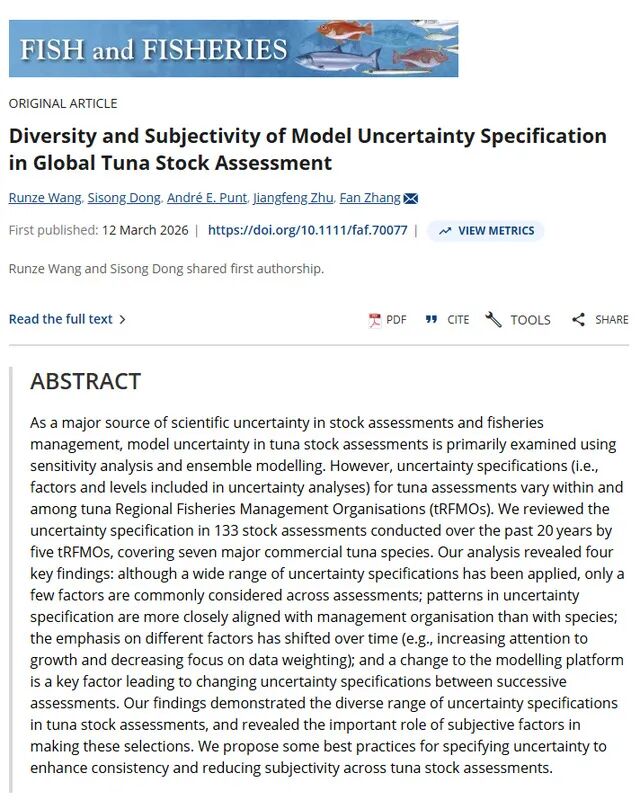
Recently, The research group of Professor Zhang Fan from Shanghai Ocean University, together with the Distant-water Fisheries International Compliance Team, in collaboration with teams including the University of Washington, USA, has made new progress in research on model uncertainty specification in global tuna stock assessment. The findings have been published in the top fisheries journal Fish and Fisheries under the title Diversity and Subjectivity of Model Uncertainty Specification in Global Tuna Stock Assessment. Wang Runze, a master's student (Class of 2024) from Shanghai Ocean University, and Dr. Dong Sisong, a postdoctoral researcher, are co-first authors of the paper, with Professor Zhang Fan as the corresponding author. This study was supported by the National Natural Science Foundation of China (Grant No. 32373132) and the Global Important Fish Species Monitoring Project, and relied on the guarantees provided by research platforms including the 'Double First-Class' construction of the Fisheries Discipline at Shanghai Ocean University and the National Engineering Research Center for Oceanic Fisheries.
金枪鱼是全球最重要的海洋渔业资源之一,其可持续开发依赖科学的资源评估。然而,不同的区域渔业管理组织在评估金枪鱼时,采用的模型假设和不确定性设置存在明显差异。研究团队通过梳理过去二十余年的一百余份金枪鱼评估报告,分析了五大区域渔业管理组织中的七种主要金枪鱼的评估数据(图1),首次系统量化了评估模型不确定规范的差异及其主观性在评估中的影响,为国际渔业管理提供了新的科学依据。
Tuna is one of the most important marine fishery resources globally, and its sustainable development relies on scientific stock assessments. However, different Regional Fisheries Management Organizations use significantly different model assumptions and uncertainty settings when assessing tuna stocks. By reviewing over one hundred tuna assessment reports from the past two decades, the research team analyzed assessment data for seven major tuna species across five RFMOs (Figure 1), and for the first time systematically quantified the differences in model uncertainty specifications and the impact of subjectivity in these assessments, providing a new scientific basis for international fisheries management.
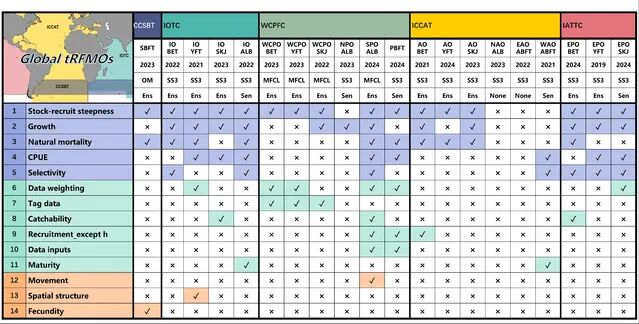
图1.全球主要金枪鱼最新评估中的不确定性设置
Figure 1. Uncertainty specifications in the latest assessments of major global tuna stocks
The study found that the choice of key uncertainty factors varies significantly among different management organizations, while within the same organization, the settings are relatively consistent across different tuna stocks. This suggests that assessment habits and management systems often have a greater influence on decision-making than biological characteristics (Figure 2). Meanwhile, over the past 20 years, the frequency of data-related uncertainty settings has gradually decreased, while uncertainty factors related to biological processes have received increasing attention. Factors such as improvements in assessment methods, changes in fishing fleet structure, and updates to stock definitions are the main reasons for changes in uncertainty settings in consecutive assessments across organizations (Figure 3).
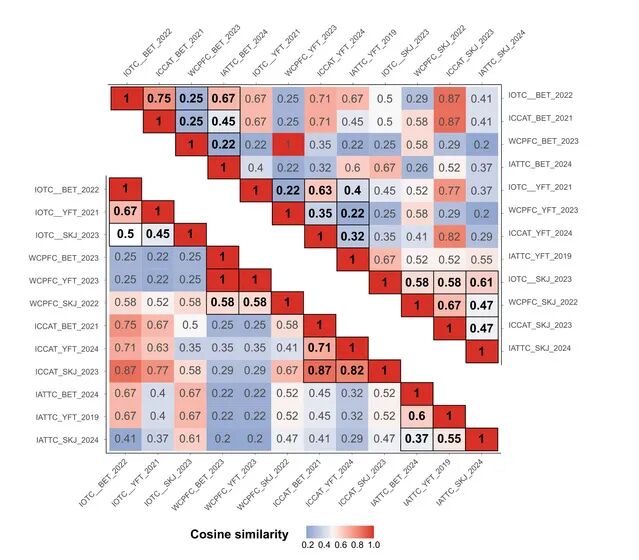
图2. 不同金枪鱼种群评估中不确定性设置的相似性
Figure 2. Similarity in uncertainty specifications across different tuna stock assessments
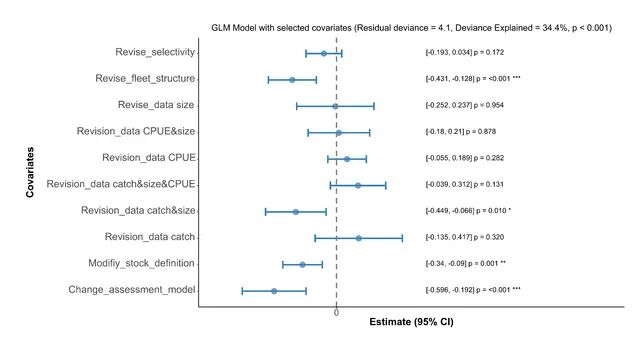
图3. 影响连续评估中不确定性设置变化的因素
Figure 3. Factors influencing changes in uncertainty settings in consecutive assessments
这一研究成果为国际渔业管理提供了重要启示:在制定管理措施时,应充分考虑模型不确定性设置的动态变化。研究建议通过跨组织协调和专家审查,提高评估方法的一致性和透明度;同时建立标准化的“不确定性清单”,确保评估中所有潜在不确定性得到合理考虑,并减少评估人员主观偏好对结果的影响。此外,团队还提出了一套评估模型最佳实践指南(图4),通过流程化方式指导不确定性设置的系统选择和设定,为未来的科学管理提供制度化保障。
The findings offer important insights for international fisheries management: the dynamic nature of model uncertainty settings should be fully considered when formulating management measures. The study recommends improving the consistency and transparency of assessment methods through cross-organizational coordination and expert review; establishing a standardized uncertainty checklist to ensure that all potential uncertainties are properly considered and to reduce the impact of assessors' subjective preferences on results. Additionally, the team proposed a set of best practice guidelines for assessment models (Figure 4) to guide the systematic selection and specification of uncertainties through a process-oriented approach, thereby providing institutional safeguards for future scientific management.
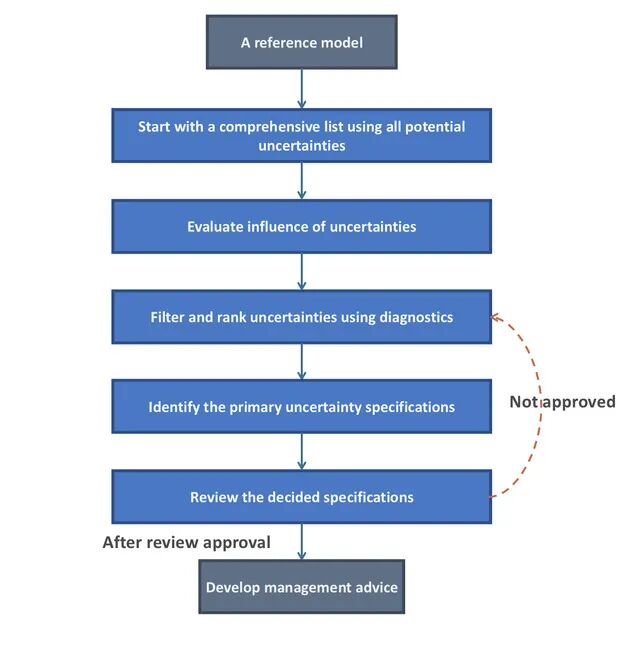
图4.不确定性设置的最佳实践指南
Figure 4. Best practice guidelines for uncertainty specification
研究团队表示,未来将持续优化不同渔业种群的评估方法,开发更科学的资源评估模型,提升对渔业资源动态的理解,并将研究成果应用于全球和区域渔业管理实践。这不仅为海洋资源保护和渔业可持续发展提供科学支撑,也将为我国在全球渔业治理及区域渔业组织谈判提供科学依据和技术方案,进一步提升我国在国际渔业事务中的学术影响力和决策话语权。
The research team stated that they will continue to refine assessment methods for different fishery stocks, develop more scientific resource assessment models, improve understanding of fishery resource dynamics, and apply the research outcomes to global and regional fisheries management practices. This will not only provide scientific support for marine resource protection and sustainable fisheries development but also offer scientific evidence and technical solutions for China's participation in global fisheries governance and negotiations within regional fisheries organizations, further enhancing China's academic influence and decision-making voice in international fisheries affairs.
(https://doi.org/10.1111/faf.70077)